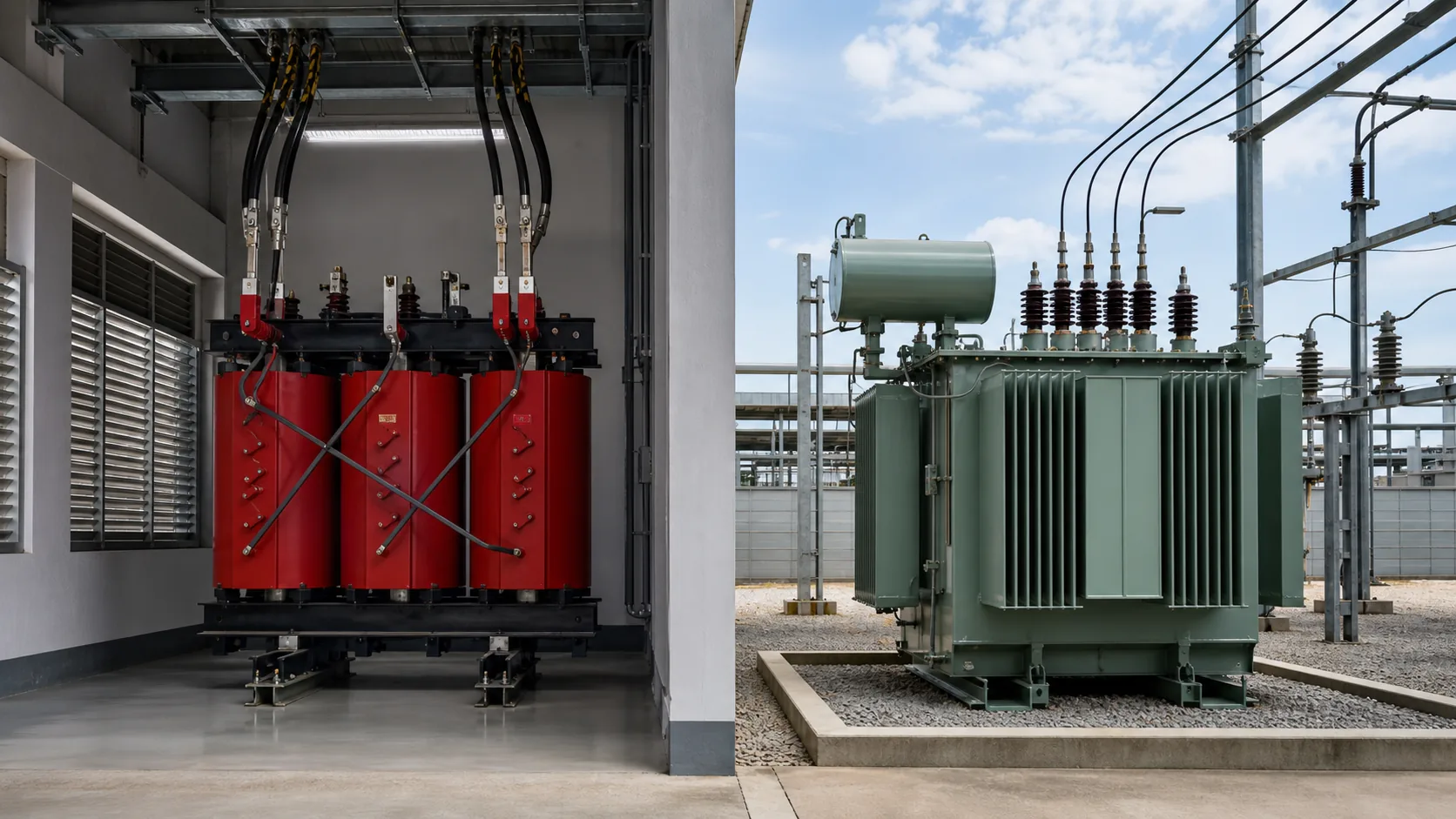
Choosing between a dry-type transformer and an oil-immersed transformer is a project decision, not a universal ranking. The correct choice depends on the electrical duty, installation environment, fire and environmental strategy, available space, maintenance plan, required performance and destination-market documents. This guide gives buyers a structured comparison and identifies the information that still needs to be confirmed for the quoted model.
Quick answer: start with the site and electrical duty
Dry-type transformers are often evaluated for indoor or occupied facilities where room layout, ventilation, fire strategy and liquid containment influence the design. Oil-immersed transformers are often evaluated for utility, outdoor and industrial distribution where liquid insulation, tank construction, cooling and accessories can be integrated into the site. These are common evaluation routes, not automatic suitability claims. Capacity, voltage, enclosure, cooling, losses and evidence must be checked for the actual model.
Construction and cooling are different design systems
A dry-type unit uses a solid or dry insulation system and depends on the specified winding construction, air circulation, enclosure and room conditions. An oil-immersed unit uses insulating liquid within a tank, with cooling surfaces or other cooling equipment selected for the rating and duty. Buyers should not infer cast-resin construction, conductor material, cooling class or enclosure from the product family name alone.
- For dry-type equipment, request the winding and insulation description, enclosure, cooling method, temperature-rise basis, ventilation needs and clearances.
- For oil-immersed equipment, request the liquid specification, tank and radiator arrangement, cooling method, bushings, tap equipment, indicators, protection accessories and containment requirements.
Indoor, outdoor, fire and environmental requirements
The installation location often changes the comparison. An indoor project may prioritize room ventilation, access, noise, clearances and the building fire strategy. An outdoor project may prioritize weather exposure, corrosion protection, drainage, foundation, security and cable approach. Oil containment and local environmental rules may apply to liquid-filled equipment. A dry-type label does not by itself prove that a unit can be placed in any occupied area, and an outdoor label does not prove suitability for every climate or corrosion category.
Capacity, voltage and load profile come before product family
Define rated capacity, primary and secondary voltage, frequency, phase, vector group, taps, impedance, neutral and earthing requirements. Add peak and continuous load, motor starting, nonlinear loads, harmonics, overload duty and future growth. If the application involves a VFD, UPS, rectifier, renewable interface or parallel operation, state it explicitly so the design can be reviewed instead of assuming a whole transformer family is suitable.
Compare losses and efficiency using guaranteed values
Neither transformer family should be described as automatically more efficient. Compare no-load loss, load loss, expected loading, operating hours, electricity cost, temperature basis and applicable test method for the offered rating. A lower purchase price can be offset by higher lifetime energy cost, but a loss comparison is only meaningful when the values refer to the same duty and documented conditions.
Maintenance and operating responsibilities
Dry-type projects still require inspection of ventilation, dust, connections, insulation condition and site environment. Oil-immersed projects may require inspection of liquid condition, leaks, seals, bushings, indicators, cooling equipment and protection devices according to the selected design and maintenance plan. Avoid claims such as maintenance-free or leak-proof unless the exact product documentation supports them.
Space, access, noise and thermal design
Request dimensions, weight, lifting points, cable entry, terminal layout, clearances and maintenance access for both alternatives. The dry-type room may need a heat-rejection and airflow study. The oil-immersed layout may need foundation, containment, radiator clearances and accessory access. Guaranteed sound and temperature-rise data should be reviewed when they affect the building or site design.
Documents and tests to request
Ask for the model-specific datasheet, nameplate, general arrangement, terminal or connection drawings, loss and impedance schedule, temperature-rise basis and agreed test plan. Standards should be identified by edition and document scope. One report for one model should not be extended to a complete product family unless the report itself supports that scope. Read the transformer FAT and test guide for the difference between routine, type and special tests.
Buyer comparison checklist
- Electrical ratings, load profile and fault duty
- Indoor or outdoor location and ambient conditions
- Fire, environmental and liquid-containment requirements
- Cooling, ventilation and heat rejection
- Losses, impedance, temperature rise and sound
- Dimensions, weight, clearances, cable entry and maintenance access
- Accessories, protection, monitoring and tap requirements
- Required standards, drawings, tests and reports
- Quantity, destination, schedule and lifecycle cost assumptions
Related transformer resources
Compare the dry-type transformer range with the oil-immersed transformer range. For a detailed enquiry, use the transformer RFQ checklist, review the oil-immersed buying guide and send the project schedule for model-specific confirmation.