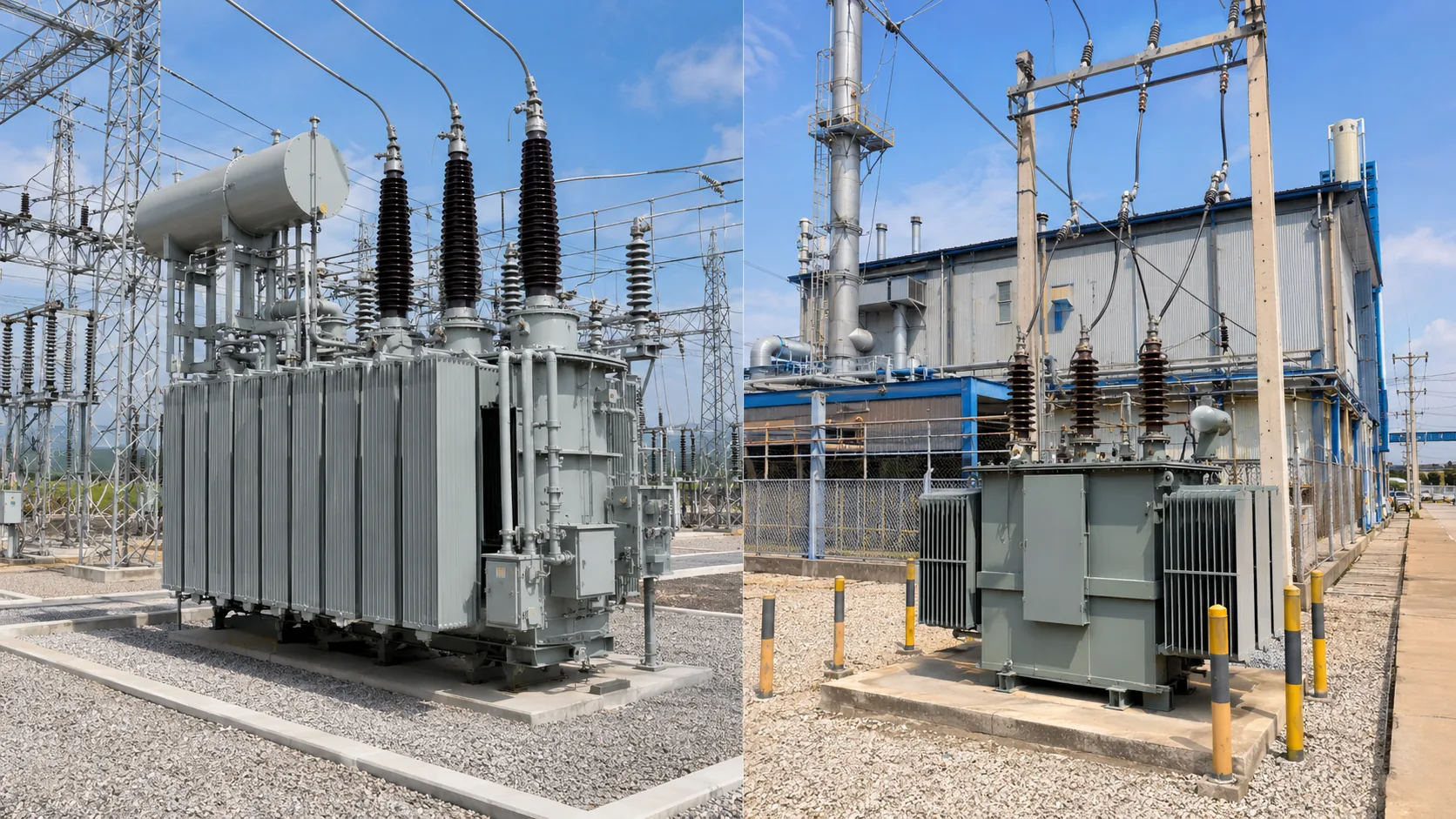
What Is a Power Transformer?
A power transformer is usually used in high-voltage transmission networks, substations, power plants, renewable energy stations, and large industrial power systems. Its main role is to step voltage up or down between transmission and sub-transmission levels.
Power transformers are commonly used where large amounts of electrical energy must be transferred over long distances or between major grid nodes. For example, a step-up transformer may increase generator output voltage at a power plant before electricity enters the transmission grid. A substation transformer may then step voltage down for regional distribution.
Typical features of power transformers include:
- Higher voltage ratings
- Larger capacity
- Customized design based on project requirements
- Stronger focus on thermal performance, insulation coordination, short-circuit withstand capacity, and reliability
- More detailed testing and documentation requirements
- Common use in substations, power plants, grid projects, and large industrial facilities
Because power transformers are often critical assets in the grid, buyers usually evaluate not only price but also design life, testing standards, manufacturing capability, delivery schedule, and after-sales technical support.
What Is a Distribution Transformer?
A distribution transformer is used closer to the end user. Its main function is to reduce medium-voltage electricity to a lower voltage suitable for commercial, residential, industrial, or utility distribution networks.
For example, a distribution transformer may step voltage down from 11 kV, 13.8 kV, 22 kV, or 33 kV to 400 V, 415 V, 480 V, or another low-voltage output used by local loads.
Typical features of distribution transformers include:
- Medium-voltage to low-voltage conversion
- Smaller capacity compared with most power transformers
- Frequent use in local distribution networks
- High importance of no-load loss, load loss, noise, safety, and installation environment
- Common installation types such as pole-mounted, pad-mounted, oil-immersed, or dry-type designs
- Use in factories, buildings, communities, farms, mining sites, and utility networks
Distribution transformers may operate for long periods with varying loads. Because there are often many units in one distribution network, efficiency and lifecycle cost can be very important.
Key Differences Between Power Transformers and Distribution Transformers
Position in the Power System
Power transformers are generally installed in transmission systems, generation plants, and primary substations. They manage high power flow across major grid sections.
Distribution transformers are installed near the final load. They supply electricity to users, facilities, industrial equipment, commercial buildings, or local distribution circuits.
In simple terms, power transformers are closer to the grid backbone, while distribution transformers are closer to the end user.
Voltage Level
Power transformers usually handle higher voltage levels, such as transmission or sub-transmission voltage. The exact voltage depends on the local grid system and project design.
Distribution transformers usually step medium voltage down to low voltage. Common primary voltages include 10 kV, 11 kV, 13.8 kV, 22 kV, and 33 kV, while secondary voltages are often 400 V, 415 V, 480 V, or similar local standards.
Buyers should always confirm both primary and secondary voltage before requesting a quotation.
Capacity Range
Power transformers are usually larger in capacity. They may range from several MVA to hundreds of MVA, depending on the substation or power plant.
Distribution transformers are usually smaller, often measured in kVA. Common ratings include 25 kVA, 50 kVA, 100 kVA, 250 kVA, 500 kVA, 1000 kVA, 1600 kVA, 2500 kVA, and similar ranges.
This is not an absolute rule, but it is a useful buyer reference: power transformers are usually selected for large-scale power transfer, while distribution transformers are selected for local load supply.
Design Priority
For power transformers, reliability under heavy electrical and thermal stress is a major priority. Buyers often pay close attention to insulation level, short-circuit strength, temperature rise, cooling method, oil preservation system, protection accessories, and factory testing.
For distribution transformers, buyers often focus on efficiency, noise, installation type, safety, maintenance, footprint, and total cost of ownership. In many projects, low losses can be more important than the lowest purchase price.
Load Pattern
Power transformers are often designed for high and relatively stable load operation in grid or industrial systems.
Distribution transformers may face more variable load patterns. A transformer serving a residential area, for example, may experience peak loads at certain times and lighter loads during other periods. For this reason, both no-load loss and load loss should be considered.
Cooling Method
Oil-immersed power transformers commonly use cooling methods such as ONAN, ONAF, OFAF, or other project-specific cooling systems.
Distribution transformers may use oil-immersed or dry-type designs. Oil-immersed units are common outdoors, while dry-type transformers are often selected for indoor locations, commercial buildings, or places with stricter fire safety requirements.
Testing and Documentation
Power transformer projects usually require more detailed technical documentation, drawings, inspection plans, and test reports. Buyers may request routine tests, type tests, special tests, and factory acceptance testing.
Distribution transformers also require proper testing, but the documentation package may be simpler depending on project scale and local utility requirements.
For both types, buyers should confirm the applicable standard, such as IEC, IEEE/ANSI, or a local grid specification.
Which Transformer Do You Need?
Choose a power transformer if your project involves:
- A power plant or renewable energy station
- A transmission or sub-transmission substation
- High-voltage grid connection
- Large industrial power intake
- MVA-level capacity
- Strict requirements for system reliability and protection
Choose a distribution transformer if your project involves:
- Supplying power to end users
- A factory, building, farm, community, or local utility network
- Medium-voltage to low-voltage conversion
- kVA-level capacity
- Pole-mounted, pad-mounted, oil-immersed, or dry-type installation
- A focus on efficiency, noise, safety, and lifecycle cost
If you are not sure, the best starting point is to define the application and load. A transformer supplier can recommend a suitable type only after understanding the voltage level, rated capacity, frequency, installation environment, load characteristics, and required standards.
Common Buyer Mistakes
Mistake 1: Only Comparing Transformer Price
A lower purchase price may result in higher losses, shorter service life, weaker accessories, or higher maintenance cost. For long-term power assets, total cost of ownership is more important than initial price alone.
Mistake 2: Not Confirming the Applicable Standard
Different markets may require IEC, IEEE/ANSI, local utility standards, or specific project specifications. If the standard is unclear, the quotation may not match the final approval requirements.
Mistake 3: Ignoring Installation Environment
Altitude, ambient temperature, humidity, dust, corrosion, seismic conditions, indoor or outdoor installation, and fire safety requirements can all affect transformer design.
Mistake 4: Missing Key Electrical Parameters
Voltage ratio, vector group, impedance, frequency, tap changer type, cooling method, and insulation level should be confirmed early. Missing parameters can delay quotation, design, and production.
Mistake 5: Underestimating Delivery and Inspection Time
Transformers are engineered products. Larger units often require design confirmation, material preparation, manufacturing, testing, inspection, packing, and shipping. Buyers should plan procurement schedules early, especially for substation and grid projects.
RFQ Checklist for Buyers
Before requesting a quotation, prepare the following information:
- Transformer type: power transformer or distribution transformer
- Rated capacity: kVA or MVA
- Primary voltage and secondary voltage
- Frequency: 50 Hz or 60 Hz
- Phase: single-phase or three-phase
- Cooling method
- Installation: indoor or outdoor
- Standard: IEC, IEEE/ANSI, or local standard
- Vector group
- Impedance requirement
- Tap changer type and tap range
- Ambient temperature and altitude
- Oil-immersed or dry-type preference
- Required accessories
- Testing requirements
- Quantity
- Destination country or port
- Expected delivery schedule
The clearer the RFQ, the more accurate the technical proposal and quotation will be.
Conclusion
Power transformers and distribution transformers serve different roles in the electrical power system. A power transformer is usually used for high-voltage, large-capacity power transfer in substations, power plants, and grid infrastructure. A distribution transformer is used closer to the final load, stepping medium voltage down to usable low voltage for utilities, buildings, factories, and local networks.
For buyers, the key is not only knowing the product name. The real decision depends on application, voltage level, capacity, installation environment, standards, testing requirements, and lifecycle cost.
If you are planning a transformer project, prepare a clear RFQ with the main electrical and site conditions. This will help your supplier provide a more accurate design, price, and delivery schedule.
FAQ
1. Is a power transformer the same as a distribution transformer?
No. Both transfer electrical energy between voltage levels, but they are used in different parts of the power system. Power transformers are usually used in transmission and substation systems, while distribution transformers are used closer to end users.
2. Which transformer is used in a substation?
Substations may use power transformers or distribution transformers depending on the voltage level and function. Primary substations usually use power transformers, while smaller distribution substations may use distribution transformers.
3. Are distribution transformers always smaller than power transformers?
In most cases, yes. Distribution transformers are commonly rated in kVA, while power transformers are often rated in MVA. However, exact classification depends on system design and local standards.
4. Which transformer is more expensive?
Power transformers are usually more expensive because they are larger, handle higher voltage and capacity, and require more complex design and testing. However, distribution transformer cost can also vary widely based on efficiency, material, installation type, and standard.
5. What information is needed to buy the correct transformer?
Buyers should provide rated capacity, primary and secondary voltage, frequency, phase, vector group, impedance, cooling method, installation environment, applicable standard, accessories, testing requirements, and destination.
6. Can one supplier provide both power transformers and distribution transformers?
Yes, some transformer manufacturers can provide both. Buyers should check the supplier's manufacturing range, testing capability, project experience, and compliance with required standards.